The Trinity Centre
Location: 111-115 Broadway, New York, NY
Status: Completed
Client: Capital Properties
Building Use: Commercial Office
Landmark Status: Individual Landmark
Size: 2 x 22-Story Buildings
The Trinity and United States Reality Buildings, located directly north of Trinity Church, were constructed in 1905-1906, under the designs of Francis H. Kimball. Ownership over the last decade has taken steps to maintain and restore these two New York City Landmarks, known today as the Trinity Centre. The excellence of completed interior lobby restoration, under the direction of Prudon & Partners, was acknowledged with a Lucy G. Moses Award. Attention has now turned to the exterior, working from the top down.
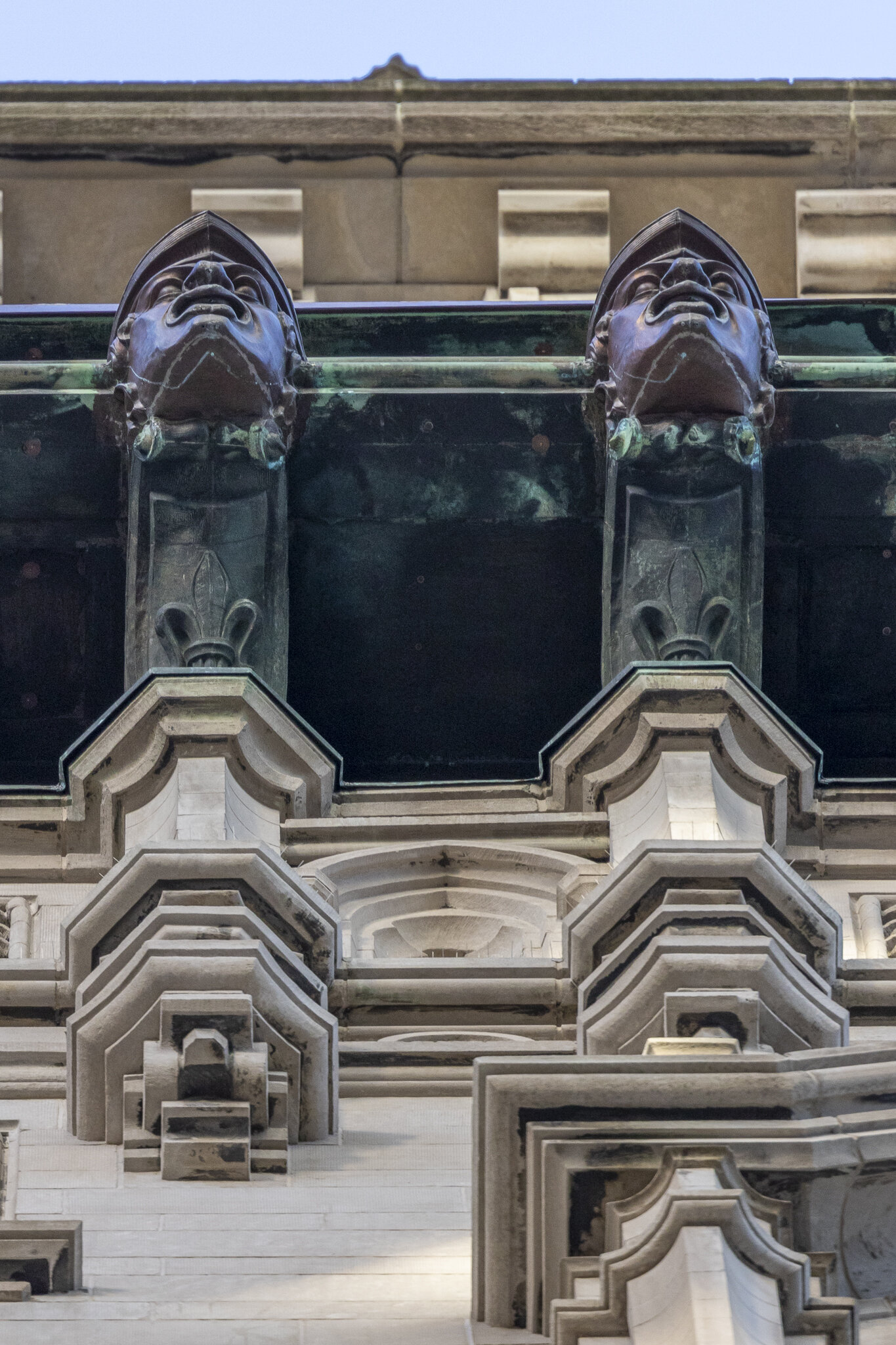
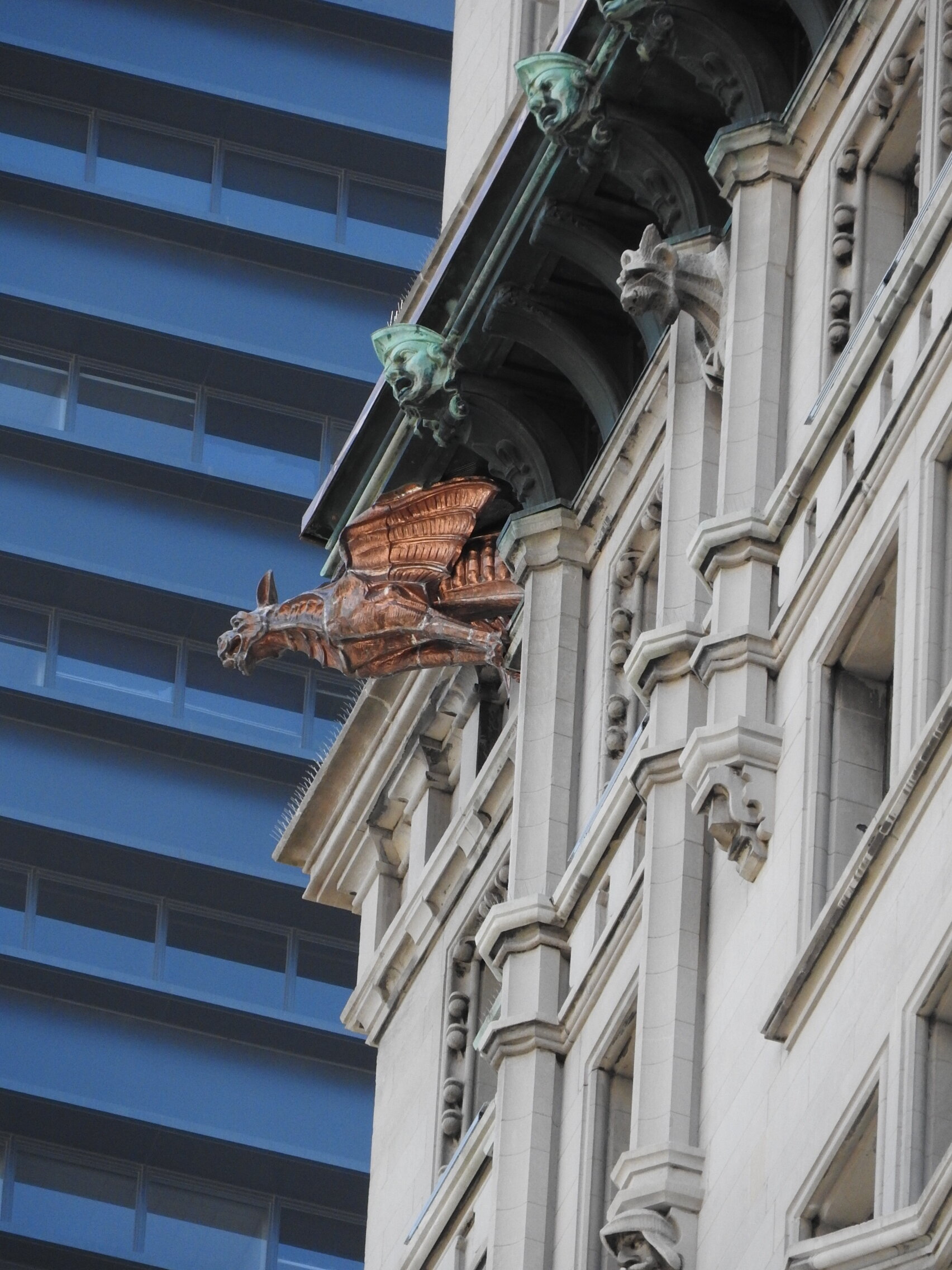
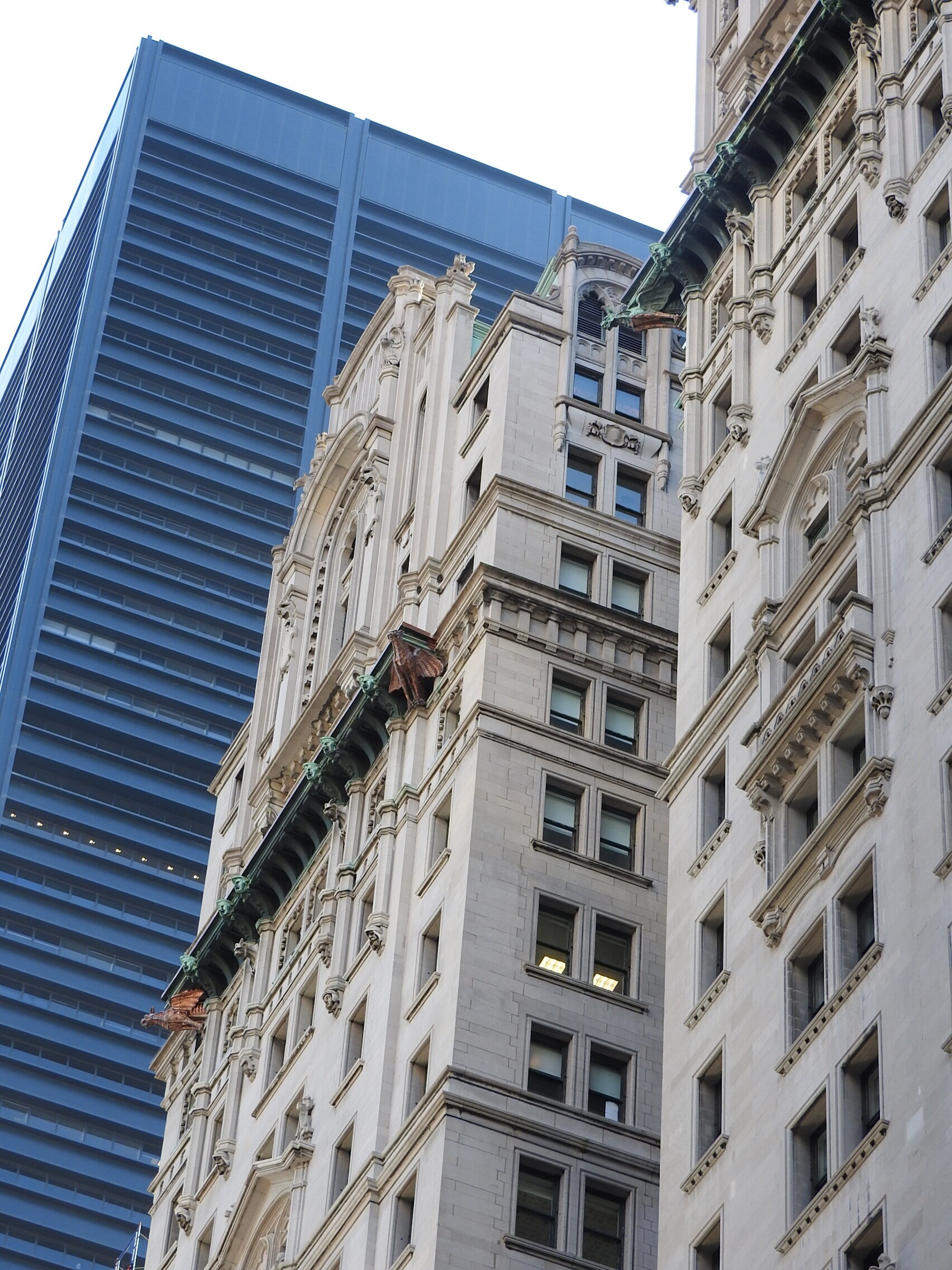
The first project of exterior restoration work, completed in 2019, is the series of ornamental copper cornices of each building. Located at the 18th floor, the total length of these cornices is nearly eight hundred feet (over two football fields in length). With over one hundred copper grotesques and griffins at each corner, copper cornices are character-defining features of the buildings’ exteriors. When cornice work started it was apparent that a significant intervention was required. Cornice water tables had failed, allowing water infiltration into the cornice cavity. Ferrous metal fasteners, located on the underside of copper, exhibited signs of corrosion. Original design flaws, including lack of expansion joints, and unclosed nesting areas behind griffins, caused significant damage. The 150-foot-long south cornice of 111 Broadway had only two drains. Finally, poor façade maintenance done in the past damaged many grotesques - suspended scaffold cabling crushed many grotesques.
Exploratory probes of the masonry slab water table revealed extensive interior damage in the cornice cavity, primarily the failure of the armature system connecting copper back to the building. Structural steel outriggers were also severely damaged, in many cases with complete loss of section. Copper work was not securely attached to the building.
The project team established the following restoration objectives for the Trinity Centre cornice project:
1. Make the cornice safe
2. Correct original design flaws:
- Add expansion joints
- Separate dissimilar metals
- Add additional drains
- Prevent bird infestation
3. Preserve original copper
4. Extend the life of the cornice 50 years
The entire masonry slab water table was removed by the General Contractor Titan Construction Services, Inc. to expose severely damaged steel, much-requiring replacement. The ferrous metal armature system, fixing steel and copper together, was also damaged, with failure at rivet fasteners, and loss of section. One hundred eighty-five replacement stainless steel armatures were installed, to securely refasten copper to steel. Teflon pads separated the dis-similar metals. Over 1,100 abandoned rivet holes of the old armatures were patched, using “cold work” patches, two copper discs screwed together.
“Hot work” (soldering) was reserved for ornament. Extensive field soldering was done by the copper restoration sub-contractor TRM Enterprises. Because of the severe damage to some grotesques, judged to be irreparable, replacements were made, twelve for 111 Broadway, and eight for 115 Broadway. Molds were made and pressed copper replicas stamped by W.F. Norman using their 1898 drop hammer press. As the last step TRM field soldered new ornament to the original copper. Finally, open seams of original grotesques were soldered close, and expansion joints installed.
Griffins were even a greater challenge - undersides of most damaged by nesting birds. Pressed copper replica bellies were carefully soldered into the undamaged copper work by TRM. Three griffins were beyond reasonable repair, with over 50% material loss - copper replicas were made by W.F. Norman and reattached, fastened to original copper by rivets, and with copper seams soldered close. Both new and original griffins were rehung with new armatures. To prevent bird nesting, concealed stainless steel mesh was installed to close-off gaps.
With the installation of additional drains and new waterproofing on the water table, cornice restoration was complete, and the project’s objectives successfully achieved. The cornices will continue to be significant features of Trinity Centre, for future generations to enjoy.
The first project of exterior restoration work, completed in 2019, is the series of ornamental copper cornices of each building. Located at the 18th floor, the total length of these cornices is nearly eight hundred feet (over two football fields in length). With over one hundred copper grotesques and griffins at each corner, copper cornices are character-defining features of the buildings’ exteriors. When cornice work started it was apparent that a significant intervention was required. Cornice water tables had failed, allowing water infiltration into the cornice cavity. Ferrous metal fasteners, located on the underside of copper, exhibited signs of corrosion. Original design flaws, including lack of expansion joints, and unclosed nesting areas behind griffins, caused significant damage. The 150-foot-long south cornice of 111 Broadway had only two drains. Finally, poor façade maintenance done in the past damaged many grotesques - suspended scaffold cabling crushed many grotesques.
Exploratory probes of the masonry slab water table revealed extensive interior damage in the cornice cavity, primarily the failure of the armature system connecting copper back to the building. Structural steel outriggers were also severely damaged, in many cases with complete loss of section. Copper work was not securely attached to the building.
The project team established the following restoration objectives for the Trinity Centre cornice project:
1. Make the cornice safe
2. Correct original design flaws:
- Add expansion joints
- Separate dissimilar metals
- Add additional drains
- Prevent bird infestation
3. Preserve original copper
4. Extend the life of the cornice 50 years
The entire masonry slab water table was removed by the General Contractor Titan Construction Services, Inc. to expose severely damaged steel, much-requiring replacement. The ferrous metal armature system, fixing steel and copper together, was also damaged, with failure at rivet fasteners, and loss of section. One hundred eighty-five replacement stainless steel armatures were installed, to securely refasten copper to steel. Teflon pads separated the dis-similar metals. Over 1,100 abandoned rivet holes of the old armatures were patched, using “cold work” patches, two copper discs screwed together.
“Hot work” (soldering) was reserved for ornament. Extensive field soldering was done by the copper restoration sub-contractor TRM Enterprises. Because of the severe damage to some grotesques, judged to be irreparable, replacements were made, twelve for 111 Broadway, and eight for 115 Broadway. Molds were made and pressed copper replicas stamped by W.F. Norman using their 1898 drop hammer press. As the last step TRM field soldered new ornament to the original copper. Finally, open seams of original grotesques were soldered close, and expansion joints installed.
Griffins were even a greater challenge - undersides of most damaged by nesting birds. Pressed copper replica bellies were carefully soldered into the undamaged copper work by TRM. Three griffins were beyond reasonable repair, with over 50% material loss - copper replicas were made by W.F. Norman and reattached, fastened to original copper by rivets, and with copper seams soldered close. Both new and original griffins were rehung with new armatures. To prevent bird nesting, concealed stainless steel mesh was installed to close-off gaps.
With the installation of additional drains and new waterproofing on the water table, cornice restoration was complete, and the project’s objectives successfully achieved. The cornices will continue to be significant features of Trinity Centre, for future generations to enjoy.